The problem
Populations are aging around the world, and retirement brings real changes: smaller social networks, new daily routines, and sometimes a loss of purpose. Staying active and engaged in this “second chapter” of life matters for older adults’ health and well-being.
Technologies like voice assistants and social robots have tried to help, but they struggle to reason, follow a continuing conversation, or go beyond narrow topics. Chatbots built on large language models (LLMs), such as ChatGPT, are much better at understanding language, keeping track of context, and giving detailed answers. Yet little was known about how retirees would actually use them in daily life, what they would want from them, and what would get in their way.
Research questions
We set out to answer three questions:
- How do retirees interact with and perceive an LLM-powered chatbot like ChatGPT?
- In what parts of their daily lives might it assist them?
- What challenges and concerns do they have when using it?
How we studied it
We recruited 25 retirees (19 women and 6 men, aged 50 to 68) through a local university for older adults. Most had little awareness of AI, and only two had used GPT before.
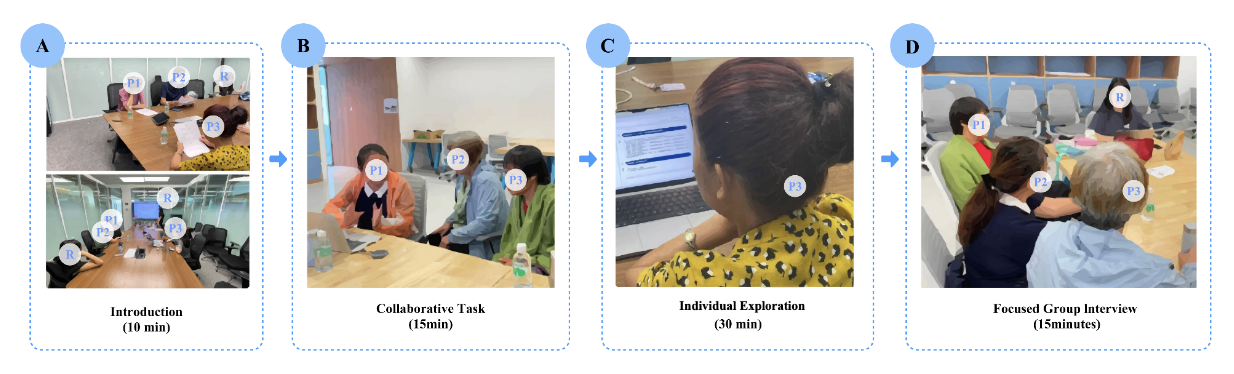
Participatory workshops. We ran seven one-hour workshops with three or four participants each, using ChatGPT 3.5. After a short introduction and training, each group shared one laptop to complete two everyday tasks together, such as writing a thank-you letter to a dance teacher or planning outdoor activities for a family holiday. Each participant then explored ChatGPT on their own on any topic they liked, and we closed with a group interview. Because participants were unfamiliar with typing on a keyboard, we also introduced the dictation tool.
Follow-up study. Nine participants continued using the mobile version of ChatGPT 3.5 at home. We interviewed them once or twice a week, for 20 to 30 minutes each time, about what they talked to ChatGPT about and what they thought of its answers. Two researchers analyzed all the recordings and chat logs with thematic analysis.
What we found
Retirees learned to talk to it, and treated it like a person. Participants prompted ChatGPT with direct questions, commands, and longer in-depth dialogues in which they added personal details step by step to get a more precise answer. Many were polite, greeting it with “Hello” and saying “Please.” Some valued that it carried none of the social pressure of talking to people:
“I can treat ChatGPT as a confidant, sharing things that are not suitable to talk with friends” (P15)
Their attitudes shifted with experience. Good answers built appreciation; wrong ones, especially on topics they already knew well, quickly eroded trust.
It supported daily life in four ways.
- Cognitive support. Participants used it to learn, for example the history of the Second World War or over 30 common English phrases; to understand confusing topics like a coffee machine’s technical terms; and to help grandchildren with school work.
- Emotional support. Some confided in it about things they did not want to share with others. After a disagreement with her daughter-in-law, one participant said it “help me analyze the reasons behind the conflicts” and eased her distress (P20).
- Creative support. It drafted speeches, letters, and social media captions. One participant who struggled to write captions for her TikTok posts said: “ChatGPT is like my second brain, because it can understand my meaning.” (P25)
- Information support. Participants asked about health, cooking, fitness, and travel. One participant, asking how to make Char Siu Bao that “blossoms,” realized her earlier failures may have come from not letting the buns ferment before steaming.
But retirees also ran into five kinds of challenges.
- Interaction modality. Speech-to-text struggled with dialects and accents, reading long text was tiring, and the version we used could not handle images.
- Information quality. It sometimes invented plausible-sounding facts, gave outdated information, or offered impractical advice. One participant dialed a hotel phone number it suggested and found it was invalid.
- Expression style. Answers felt cold when participants wanted warmth, or long-winded when they wanted something concise.
- Cultural differences. It struggled with traditional Chinese poetry and missed cultural interests, recommending only natural scenery when older visitors wanted to see a mountain’s famous Taoist temples.
- Information security. Several worried about their personal information being leaked, while a few felt that, as ordinary people, they had little to lose.
Takeaway
Retirees were not passive or reluctant users: they quickly built their own ways of working with ChatGPT and found real value in it as a tutor, a writing aid, an information source, and sometimes an emotional companion. To serve them well, LLMs need to support multimodal interaction, such as voice and video, that fits older adults’ abilities; respond with more empathy; adapt to local culture and dialects; provide accurate, timely information; and protect their privacy and security.