Under review#health
StressTalk: Designing and Evaluating a Sensing-Guided Conversational System for Understanding Daily Stress
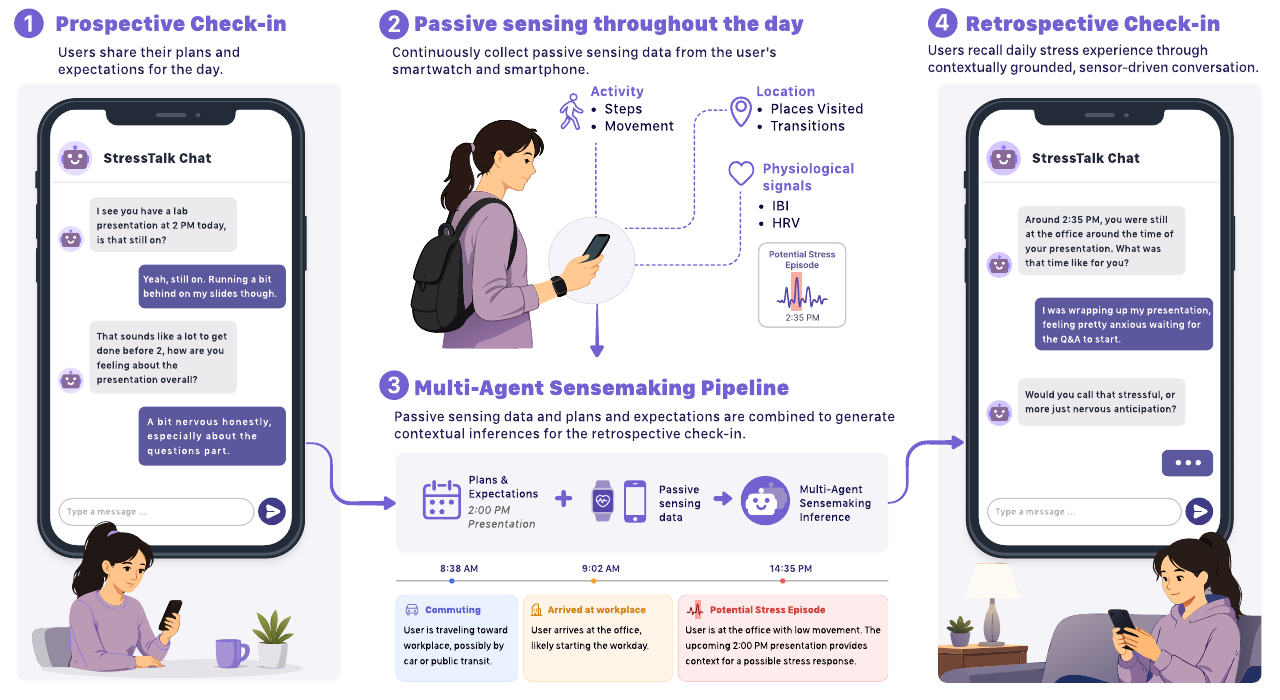
TL;DRSmartwatches can flag moments that look stressful, but only the person knows what actually happened and how it felt. StressTalk pairs passive sensing with morning and evening conversational check-ins that revisit sensor-detected stress episodes, and even quiet periods. In a six-week study with 21 participants, people more often described appraisals, changing feelings, and coping than with EMA, and 15 of 21 preferred StressTalk for long-term reporting.
Abstract
Wearable devices can detect potential stress episodes from physiological signals, but understanding subjective stress requires people's accounts of what happened and how they felt. We present StressTalk, a system combining passive sensing, multi-agent sensemaking, and conversational check-ins to understand people's daily stress experiences. A start-of-day prospective check-in captures users' plans and expectations; an end-of-day retrospective check-in uses inferred context to revisit sensor-detected potential stress episodes and even periods without any detected episodes. In a six-week within-subjects deployment with 21 participants, we found that StressTalk captured similar kinds of activities and stressors as time-contingent ecological momentary assessment (EMA), but, with StressTalk, participants more often described appraisals, changing feelings, and coping responses. We also found that participants reported stress or uncertainty even during physiologically quiet periods, when the watch recorded data but the system detected no episode, highlighting the limits of sensing alone for understanding subjective stress. Although StressTalk required more time and imposed a higher workload, 15 of 21 participants preferred it for long-term reporting. Six domain experts valued participants' explanations but emphasized the need to scrutinize inferred context. Our findings highlight the role of ongoing human input in interpreting ambiguous sensing data while balancing reporting detail and effort.

