
The problem
More than 750 million people over the age of 15 worldwide cannot read or write. In China, there were still 37.75 million illiterate people in 2021, and illiteracy is particularly severe in rural areas. Traditional adult literacy programs, such as government-run night schools, offer only basic, short-term instruction, struggle with high dropout rates, and have become less available as resources shifted to other goals.
Online learning does not easily fill the gap. MOOCs, video tutorials, and online discussion groups all assume learners can already read and write well enough to navigate them.
The idea
Livestreaming platforms such as Douyin and Kuaishou reach huge urban and rural audiences, are video-based rather than text-based, and are simple to use. Recently, streamers in China began using them to volunteer as literacy teachers for adults. Unlike audiences for gaming or e-commerce streams, these viewers are mostly low-literate, which calls for very different ways of teaching and interacting. We asked three questions:
- Why do streamers teach, and viewers watch, adult literacy livestreams?
- How do streamers teach and interact with viewers?
- What challenges do streamers and viewers face, and how do they cope?
How we studied it
We used a mixed-methods approach in two stages. First, two researchers observed livestreams from 20 adult literacy streamers on Douyin and Kuaishou over 7 days, about 15 hours of livestreamed content in total, taking notes and screenshots without interacting. Then we conducted semi-structured interviews with 12 streamers and 10 of their viewers, recruited through the platforms and the streamers’ group chats.
What we found
Why they take part. All the streamers we interviewed had prior teaching experience, and most were unemployed or retired. Beyond sharing their knowledge and some supplementary income from selling books or courses, most were driven by care for adults left behind by formal education. Notably, they avoided asking viewers for virtual gifts, knowing many struggle with smartphone interfaces.
“Adults often lack access to formal education and are left without anyone to teach them, while children have access to schools and teachers” (S4)
Viewers wanted to improve their literacy, often after everyday struggles or even discrimination. Nine of the ten had no formal education. They valued livestreams because they were free, flexible, easy to use, and filled the gap left by vanishing offline options:
“Night schools aren’t available like they used to be.” (V10)
How they teach. Streamers focused on what adults need for daily life: Pinyin (the phonetic system used to type Chinese), commonly used Chinese characters, and digital skills like typing on a smartphone keyboard, using a search engine to look up words, and even how to post a comment during a livestream.
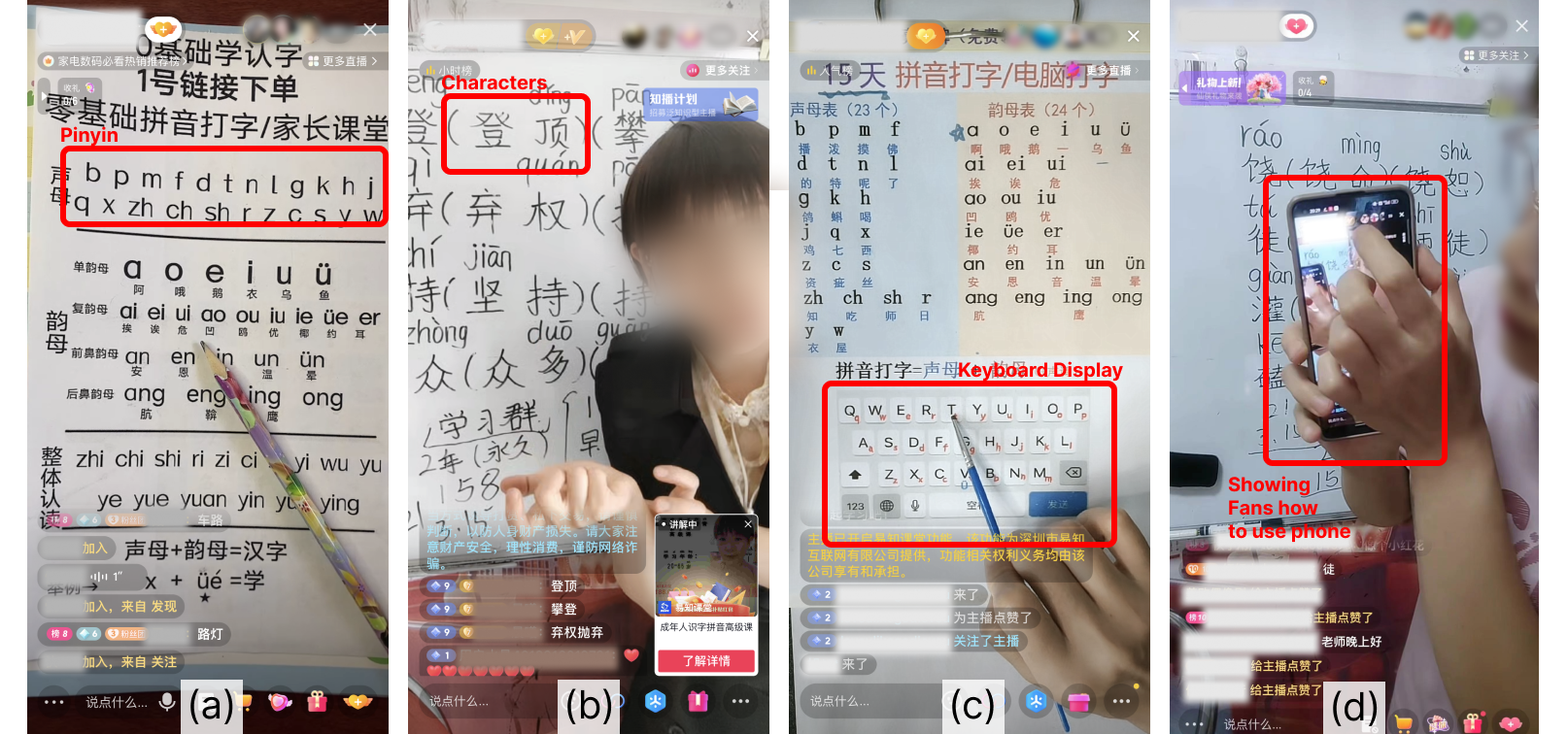
They also repurposed features built for entertainment. Live calls let streamers hear viewers read aloud and correct their pronunciation on the spot, sometimes with several learners on the call at once. Text and voice comments let viewers practice typing or reading aloud without joining a call.
“During live calls, the streamer can directly correct my pronunciation, enabling me to make faster improvements. This immediate feedback is something I can’t get from other learning methods” (V1)
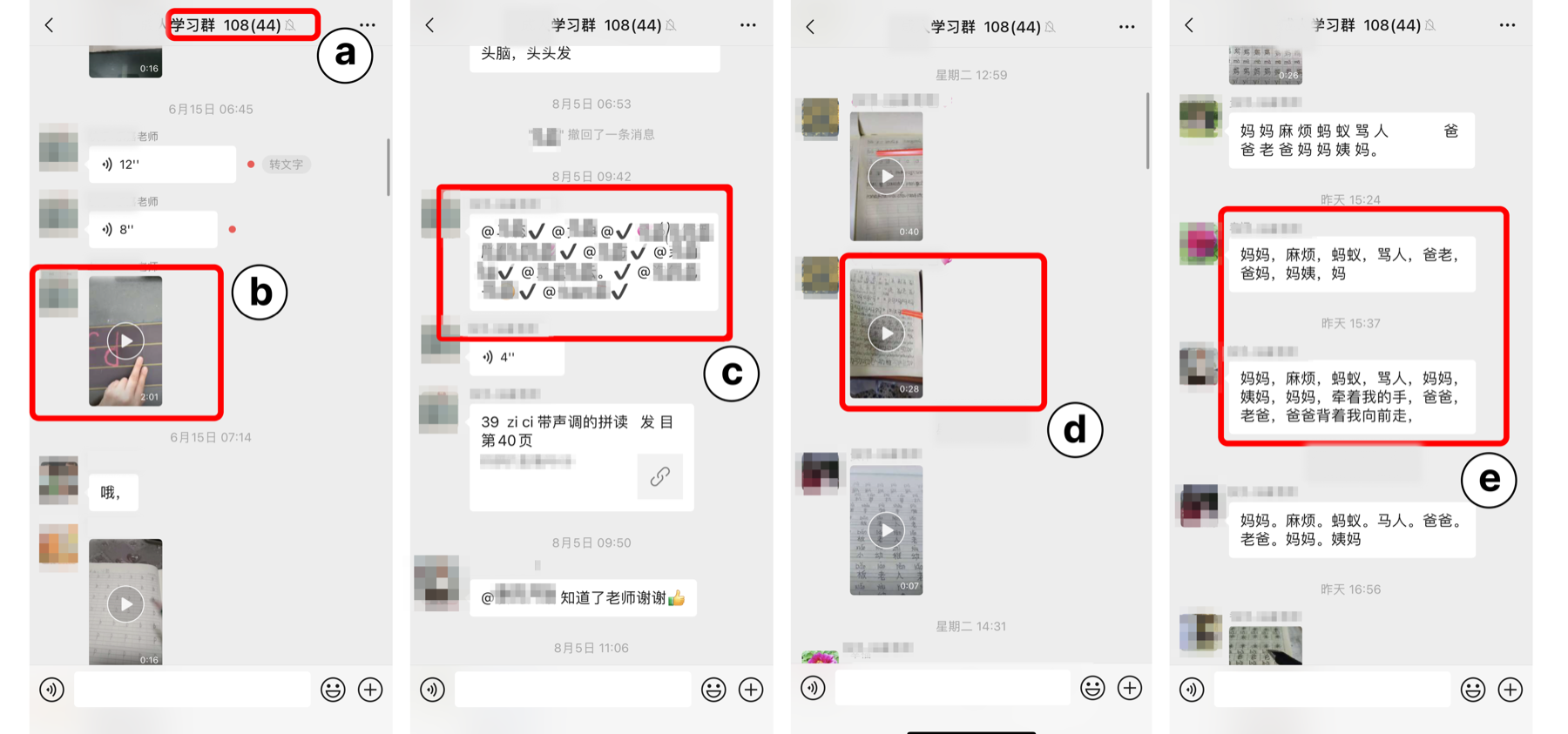
Teaching continued beyond the stream. Many streamers invited fans into tiered WeChat groups organized by literacy level, posted daily instructional videos and assignments, and gave feedback on the work fans submitted. These groups also became supportive communities, where some viewers took on a teaching-assistant role for their peers.
What gets in the way. Both sides worried about unqualified streamers teaching incorrect pronunciation or strokes, the difficulty of keeping up with live sessions, and trolls. Streamers juggled a fragmented set of tools and a heavy grading workload, and felt that platform algorithms, which favor streams that generate gifts and sales, limited their reach. Viewers faced embarrassment about learning in public, confusing interface features, and, for older learners, steep learning curves.
“At first, I was too afraid to join the live call. I already stuttered when reading alone, let alone speaking with the streamer in front of so many viewers.” (V5)
Takeaway
Adult literacy livestreaming turns entertainment platforms into an accessible, community-based classroom for people traditional programs have missed. To support it, platforms could help streamers make sense of large volumes of comments, let low-literate viewers simplify their interface, auto-generate short review videos from long sessions, count social impact alongside revenue when promoting streams, and verify teachers and moderate trolls to keep the space safe. With support from platforms, governments, and communities, livestreaming could help advance educational equity for marginalized adults.

