
The problem
Smell is easy to overlook, yet it is closely tied to emotion and memory. Scents can affect attention, judgment, and mood, and adding smell to media has been explored for entertainment, art, education, advertising, and medicine. HCI researchers have started using scent to enrich interactive experiences, for example to make VR more immersive.
But in those systems the scent is usually preset. People differ in which smells they like, and how a scent is received depends on both the scent and the person. Personalized scents could help trigger memories and emotional responses, yet existing olfactory delivery systems tend to be expensive and lack simple interfaces that let general users formulate their own.
The idea
What if creating a personal scent were as easy as dragging a few sliders? AromaBlendz is a platform that pairs a small blending machine with an accessible interface, so that anyone can mix essential oils into a scent profile of their own, smell it before committing, and reproduce it later with precise, repeatable proportions.
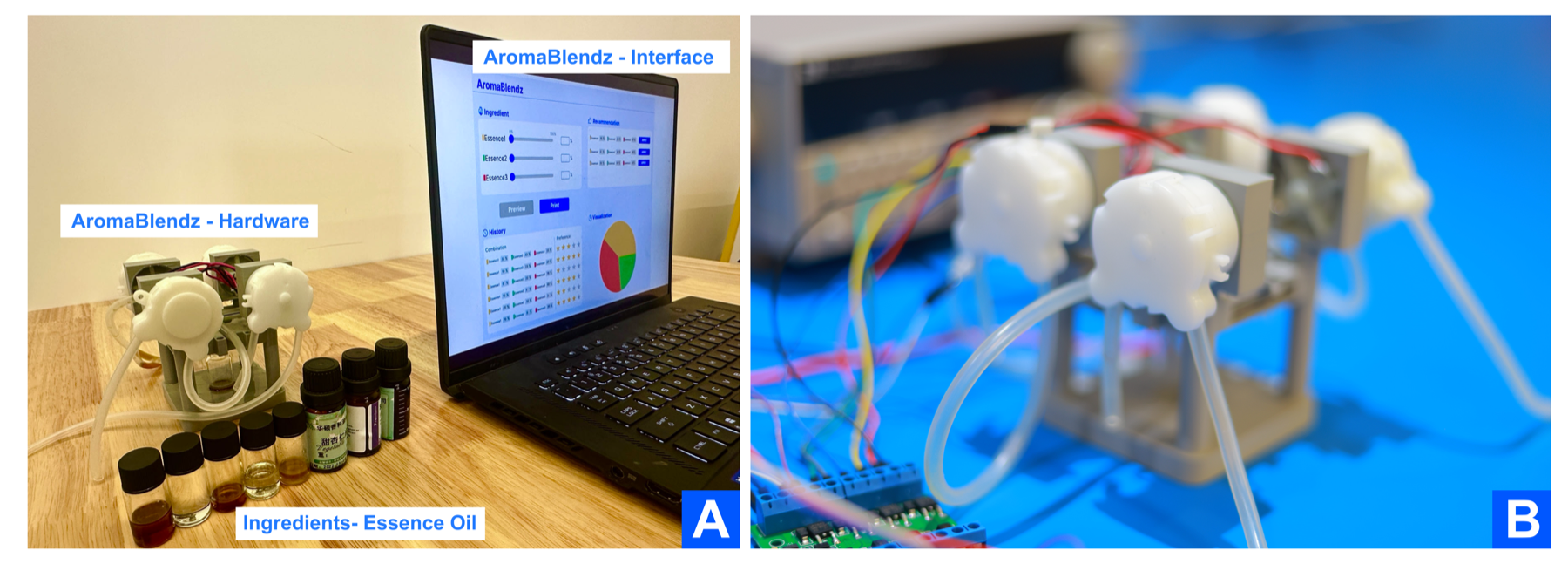
How we built it
Software. The interface has four parts:
- Ingredients, where users set the proportion of each essence with a slider, then click Preview or Print.
- Recommendation, which suggests formulas that can be applied to the sliders with one click.
- History, which records every previewed and printed recipe and lets users rate it with stars.
- Visualization, a pie chart showing the proportion of each ingredient.
Ratings feed the recommendations. A MySQL database stores both the recipes a user has tried and a set of preset recipes. When a user rates a recipe very highly, AromaBlendz recommends similar recipes; when they rate one very low, it recommends something different.
Hardware. The device is 3D-printed in PLA and holds four peristaltic pumps. Tubes from the pumps converge on a hollow center so the oils drip together into the same spot. In the middle are two layers: a preview layer, where users can insert fragrance paper to smell the current formula, and a baffle. The finished blend is collected in a bottle on the bottom platform. An Arduino UNO with an ESP8266 receives Preview and Print commands from the interface over UDP, and the proportion of each oil is controlled by how long each pump runs.
Using AromaBlendz
Creating a scent takes a few simple steps: install the ingredients, set their proportions, preview the mix, and print the final blend.

Previewing lets users smell an approximation of the final blend and adjust it before committing. Once they are happy, Print blends the oils in the chosen proportions to produce a physical scent.
Where it could go
- Olfactory training. Actively smelling different scents twice a day over several months can help rehabilitate the sense of smell. Because AromaBlendz precisely controls the concentration of each component and records users’ responses, it could support personalized training programs, for example helping older adults or professional evaluators.
- Tools for scent designers. Sliders, flexible blending ratios, and saved recipes could help olfactory designers craft scent menus or customer-tailored fragrances, with version management to iterate and collaborate.
- VR. Users could pre-select and customize the scents they want to encounter in a virtual environment, for leisure as well as education, training, and therapy.
Takeaway
Personal scent does not have to depend on expensive equipment or expert knowledge. By combining low-cost hardware with a simple interface for previewing, saving, and rating blends, AromaBlendz makes custom scents something people can create on demand. As next steps, we plan user studies to understand the prototype’s effectiveness and user experience, and to derive design guidelines for future olfactory interfaces.

