The problem
New cancer therapies have helped patients live longer, but they have also revealed a side effect that used to be overlooked: cardiotoxicity, heart damage caused by cancer treatment. For certain cancers and treatments, it may account for up to 30% of the cardiovascular complications seen in cancer patients, and it can appear anywhere from a few weeks to more than ten years after treatment.
There is no unified practice for detecting it or monitoring the related symptoms, and little is known about how clinicians actually handle it day to day. Before designing any technology, we wanted to understand that workflow from the clinicians’ side.
What we did
We conducted semi-structured interviews, about 40 minutes each over Zoom, with seven clinicians: oncologists from several specialties, a hematologist, and a cardiologist. Each recalled a recent cardiotoxicity case, walked us through how it was handled, and shared views on how digital health technologies could fit into their work.
How decisions are made today
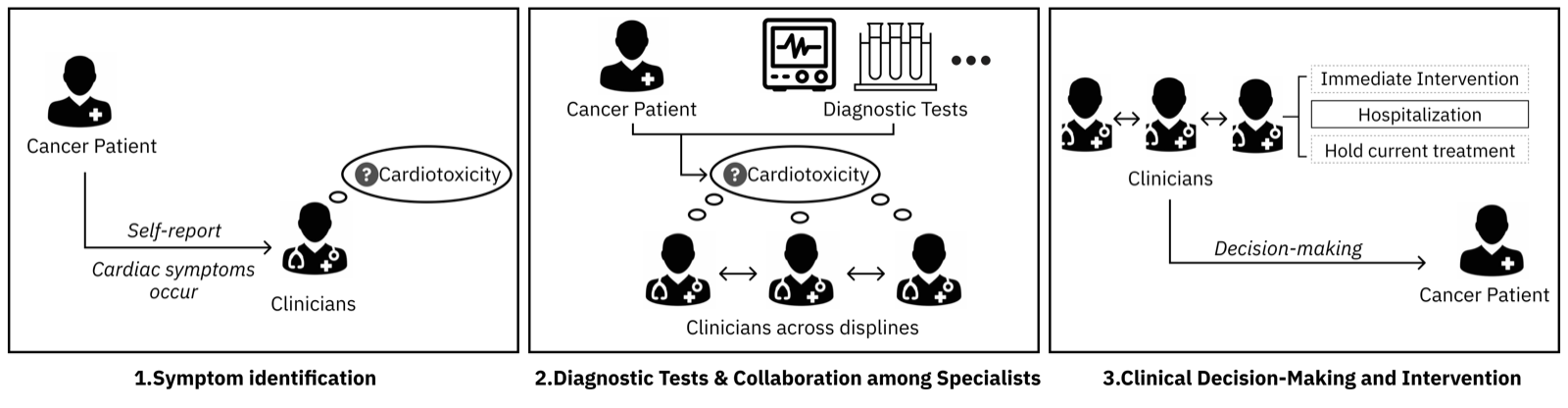
We organized clinicians’ practice into three stages:
- Symptom identification. In the hospital, routine monitoring can catch even silent problems. Once patients go home, clinicians depend almost entirely on patients reporting symptoms such as chest pain, shortness of breath, or fatigue, through patient-portal messages, phone calls, or the ER.
- Diagnostic testing and collaboration among specialists. Clinicians run tests such as EKGs and echocardiograms, rule out other causes, and often bring in cardiologists.
- Clinical decision-making and intervention. Options range from hospitalization to stopping or changing the cancer treatment to continued monitoring. These decisions are high-stakes because the patient’s survival also depends on the cancer treatment itself.
Where it breaks down
Diagnosis is ambiguous. Many symptoms overlap with ordinary chemotherapy side effects: “Rash is caused by those chemotherapies as well, so it is really hard to differentiate what is causing it.” (P1) Symptoms vary across cancer types, some patients have none at all, and standard tests can come back inconclusive or arrive late.
Monitoring at home relies on self-reports that patients downplay. Patients may not want to feel like a burden, fear their treatment will be reduced or stopped, or live far from the cancer center. Existing survey tools are not specific to cardiotoxicity.
Guidelines lag behind new treatments.
“So much of this that it’s very new, and the guidelines for how we diagnose and identify it probably lag the actual clinical, you know, outcome and what we see in the clinic.” (P1)
What clinicians want from technology
Clinicians’ central need was early detection. They saw promise in wearables for continuous monitoring between visits, since patients’ episodes rarely happen in the clinic, and in AI that automates manual risk scoring and reduces documentation burden. But they were clear about its role:
“AI is supposed to be my assistant, not my replacement.” (P4)
They also raised concerns: risk scores need validation and clear next steps (“What do we do with it?”), constant alerts cause fatigue, and it must be clear who is responsible for watching the new stream of data.
Takeaway
Cardiotoxicity care is a collaborative, high-stakes process across specialties, and it keeps changing as new cancer treatments arrive. Supportive tools should enable continuous monitoring and early risk prediction, but they must also clarify responsibility, act as an aid rather than a decision-maker, stay grounded in clinical evidence, and adapt as clinical workflows evolve.

